
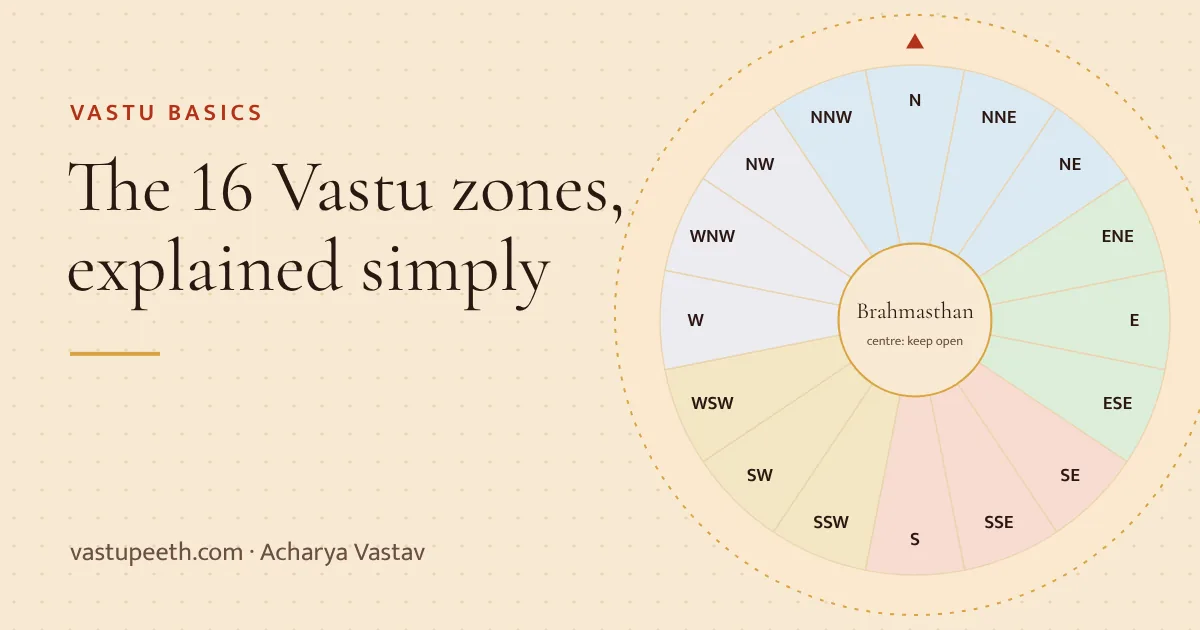
The 16 Vastu zones are 16 equal slices of your home, each 22.5 degrees wide, measured from the centre of the plan. Each slice is linked with one part of life, such as money, health, sleep or studies. When a zone holds an activity and colours that suit it, that part of life tends to run more smoothly.
Here is the short version. The North brings new chances, the North-east keeps the mind clear, the South-east runs your cash flow and the South-west holds your relationships. The other twelve zones fill in the detail between these four corners.
Below, we explain what each zone controls, what to keep there and what to move out. You can check your own home as you read.
How the 16 Vastu zones are mapped
Start with the eight main directions. Split each gap between them in half and you get 16 zones. Each zone covers 22.5 degrees of the full circle.
To mark them on your home, follow these steps.
- Take a scaled floor plan. A rough sketch drawn by hand will throw the zones off.
- Mark the middle of the covered area. Leave out open balconies, porches and terraces.
- Stand at that spot with a compass held level. Keep it away from steel almirahs, the fridge and wiring.
- Note where North falls in degrees, then divide the circle around that point into 16 slices of 22.5 degrees.
- Take a second reading from a nearby spot and use the average.
The wheel below shows all 16 zones, shaded by element. Water takes four zones along the North side: NNW, N, NNE and NE. Air takes ENE, E and ESE. Fire takes SE, SSE and S. Earth takes SSW, SW and WSW, and Space takes W, WNW and NW.
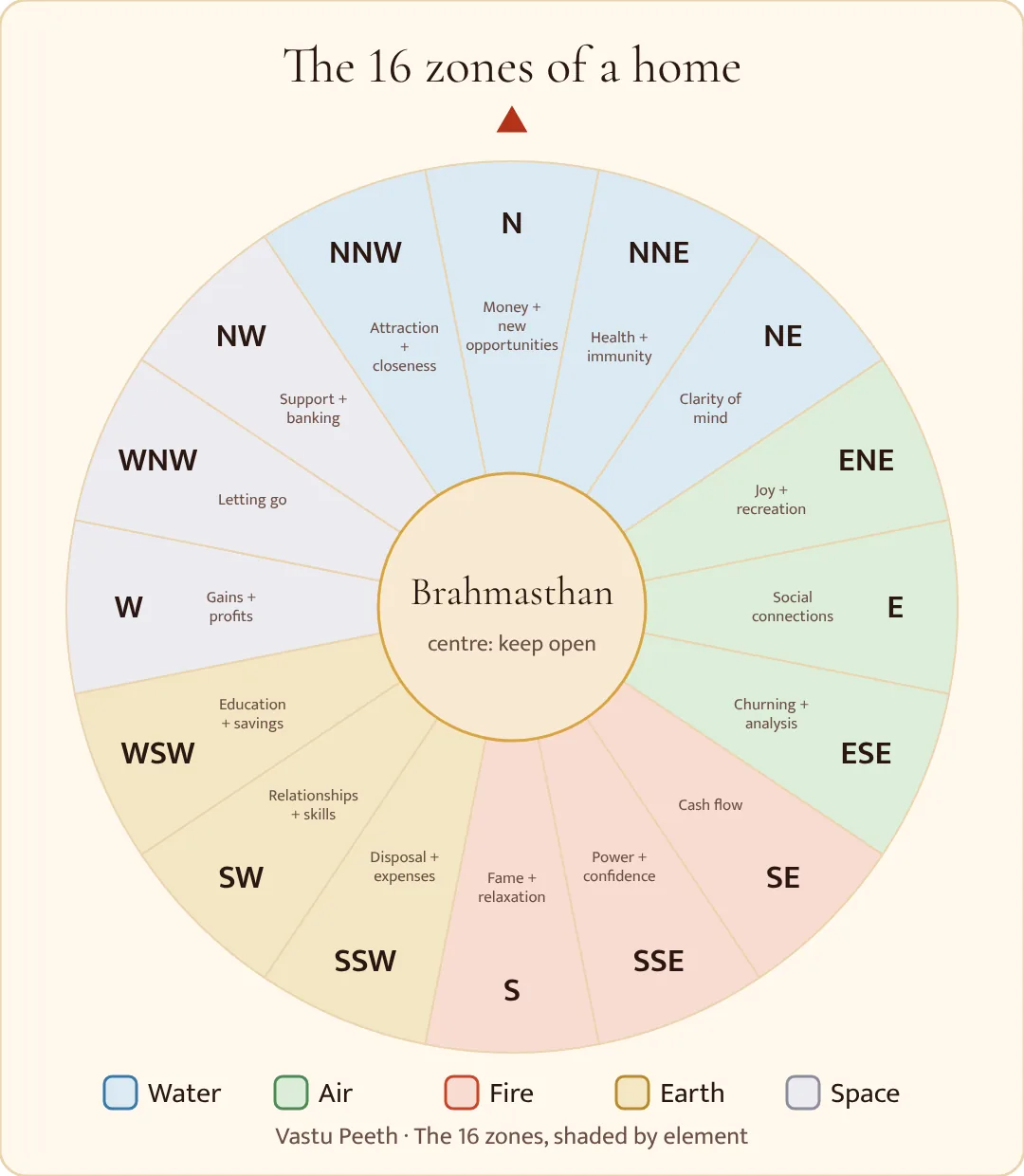
Vastu directions and their meaning, zone by zone
For each zone we give its theme, then one or two things that help it and one thing that hurts it. Our complete Vastu zone guide lists more items for every direction.
The Water zones on the North side
- North-north-west (NNW): attraction and closeness. A couple’s bedroom or a product display works well here. Keep stored water and red or pink out.
- North (N): money and new opportunities. Keep it open and tidy, with a painting of green fields or forest. A stove or a toilet here slows new openings.
- North-north-east (NNE): health and immunity. Keep a water jug and the first-aid box here. Move heavy machines, such as an inverter, elsewhere.
- North-east (NE): clarity of mind. It suits prayer, meditation and reading. A toilet, kitchen or storeroom here is the hardest problem to live with.
The Air zones on the East side
- East-north-east (ENE): joy and recreation. Hang happy family photographs and keep healthy green plants. Clear out old, unused things.
- East (E): social connections. A dining table or a picture of the rising sun on the East wall suits it. Grey tones and storage do not.
- East-south-east (ESE): churning and analysis. This is a good place for the washing machine or dustbin. Avoid sleeping or sitting here for long hours.
The Fire zones on the South side
- South-east (SE): cash flow. It is the first choice for the kitchen. Add a red bulb or red flowers, and remove blue, black and mirrors.
- South-south-east (SSE): power and confidence. A pantry or a symbol of courage fits here. Blue tones weaken it.
- South (S): fame and relaxation. Sleep comes easily in a bedroom here. Swap dark blue or black for soft warm shades.
The Earth and Space zones on the West side
- South-south-west (SSW): disposal and expenses. A toilet or dustbin is fine here. Never keep the cash locker in this zone.
- South-west (SW): relationships and skills. The master bedroom and the wedding album belong here. Move out the washing machine, plants and red lights.
- West-south-west (WSW): education and savings. Put the study table and books here. Keep toys, games and red, green or black decor out.
- West (W): gains and profits. Keep the locker, valuables and legal papers here. Heavy plants and red or green decor clash with it.
- West-north-west (WNW): letting go. A store, utility area or toilet sits well here. It is a poor place for a bed or family photos.
- North-west (NW): support and banking. A pantry, washing machine or staff area suits it. Keep medicines elsewhere.
Each zone also has its own helpful shades. You can find them in our guide to Vastu colours for every direction of the home.
The Vastu Purush Mandal behind the zones
The 16 zones sit on the Vastu Purush Mandal (the energy grid of a building). We lay this grid over your scaled plan, centred on the middle of the covered area. Each zone then carries its own theme and its own element.
The grid holds 45 energy fields, called Devtas (the forces of the space). Each field has its own quality. Element logic explains the rest: the North-east is a Water zone, so it stays light, and the South-west is an Earth zone, so it stays steady.
Of the 45, thirty-two line the edge of the plot. They become the 32 positions an entrance can take. Numbering runs clockwise, so N1 sits beside the North-west corner and E1 beside the North-east corner. The third and fourth positions on each side are naturally strong. That is why we always check where your main door falls among the 32 entrance positions before giving advice.
At the very centre lies the Brahmasthan (the centre of the home). Keep it open and bright, without heavy furniture or clutter. You can read more about the Vastu Purush Mandal and its 45 energy fields in our guide.
Vastu zones and their effects on daily life
Each zone also links to a pattern you may notice at home. When we hear a concern, we look at the matching zone first. This table shows where to start.
| What you notice | Zone to check first | A first step |
|---|---|---|
| Few new openings | North | Clear clutter and red decor. |
| Payments stuck | South-east | Add warm light, remove blue. |
| Illness that lingers | North-north-east | Keep medicines here, and see your doctor. |
| Overthinking | East-south-east | Stop sleeping or sitting here. |
| Poor sleep | South | Swap dark blue for soft warm tones. |
| Money leaking away | South-south-west | Move the locker to the West. |
| Distance between partners | South-west | Hang a happy couple photo here. |
| A child who cannot focus | West-south-west | Place the study table here. |
| Effort without results | West | Keep valuables and papers here. |
A note on health and money. Vastu supports your effort, but it never replaces a doctor, a lawyer or a CA. Use it alongside their advice.
Common mistakes when reading the 16 Vastu zones
- Reading from the door. Zones are always measured from the centre of the plan, not from where you enter.
- Trusting a phone near metal. A compass app next to the fridge can be off by many degrees. A small error can push a room into the next zone.
- Judging the house by its facing. A South-facing home is not unlucky. The exact position of the entrance matters far more.
- Calling a zone good or bad. No zone is bad. A toilet suits the West-north-west and harms the North-east. The question is always what sits where.
- Adding remedies everywhere. A symbol in the wrong zone can create a fresh problem. Map first, then place.
The zones also follow a deeper logic. Our post on the five elements of Vastu and how they interact explains why blue hurts the South-east and red hurts the North-east.
Where to start in your own home
Walk through the house with your marked plan. In each zone, note the room and the three biggest objects in it. Then fix the easy things first: clutter, colours, the dustbin, the bed and the desk.
If you are not sure which part of life to focus on, try our one-minute Vastu self-check. It points you to the zones linked with your concern.
Ask for expert help when the problem is structural. Examples include a North-east toilet or kitchen, a missing or extended corner, or several concerns at once. A cut corner weakens the qualities of its zone, while an extension makes them stronger. Cuts in the North-east or South-west need the most care. A full reading also matters before you buy or rent.
Once you know your 16 Vastu zones, small changes start to make sense. If you would like Acharya Vastav to mark them for you, send us your floor plan through the appointment page. We will tell you calmly what to change first.
Frequently asked questions
How many degrees is each Vastu zone?
Each zone covers 22.5 degrees, so 16 of them complete the 360-degree circle. Because the slices are narrow, an error of even a few degrees in your compass reading can place a room in the wrong zone.
Which is the most important zone in Vastu?
No single zone matters most for everyone. The right zone depends on your concern, such as the South-east for cash flow or the West-south-west for studies. That said, we always keep the North-east light and the centre open.
Is the 16-zone system different from the eight directions?
It builds on them. The eight main directions stay the same, and the space between each pair is split once more. This gives finer detail, so advice can be matched to a smaller part of the room.
Can I apply the 16 zones to a rented flat?
Yes. The zones describe how a space works, not who owns it. In a rented flat you mostly work with furniture placement, colours in fabrics and decor, and clearing clutter.
