
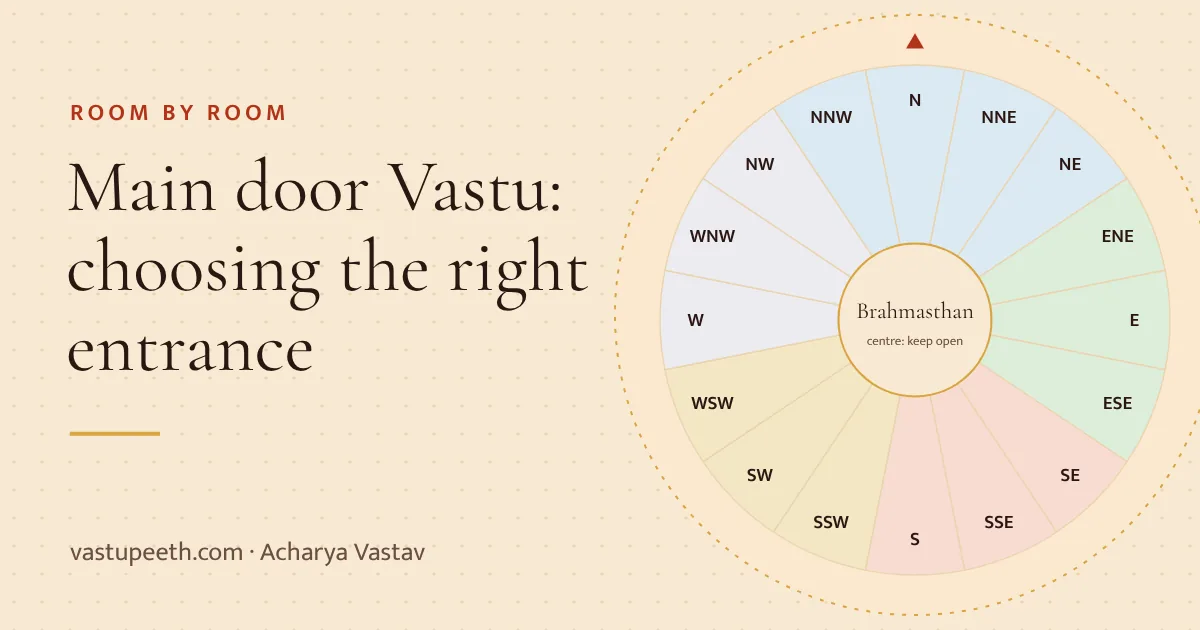
Main door Vastu starts with one simple question: where exactly does your entrance sit? Vastu splits each side of a home into eight entrance spots. That gives 32 possible positions for the main door. Only a few are naturally strong, and most of the others can be balanced.
Eight spots are favourable: N3 and N4 on the North side and E3 and E4 on the East. On the other two sides, they are S3, S4, W3 and W4. So a South-facing home can have a very good entrance. The exact spot counts for more than the facing.
A phone compass at the doorway will not tell you which spot you have. The entrance has to be read on a scaled floor plan, measured from the true centre point of the built-up area.
How the 32 entrances Vastu method works
Imagine your home as a round cake. Cut it from the centre into 32 equal slices, each about 11.25 degrees wide. Every side of the house now holds eight slices. Each slice is one entrance position.
The numbering goes clockwise around the plan, with North at the top:
- N1 begins at the North-west (NW) corner. The count runs East along the North wall to N8 at the North-east corner.
- E1 begins at the North-east (NE) corner. The count runs South along the East wall to E8 at the South-east corner.
- S1 begins at the South-east (SE) corner. The count runs West along the South wall to S8 at the South-west corner.
- W1 begins at the South-west (SW) corner. The count runs North along the West wall to W8 at the North-west corner.
Spots 3 and 4 on every side sit just before the middle of that side, counted from its starting corner. That is why they are easy to remember.
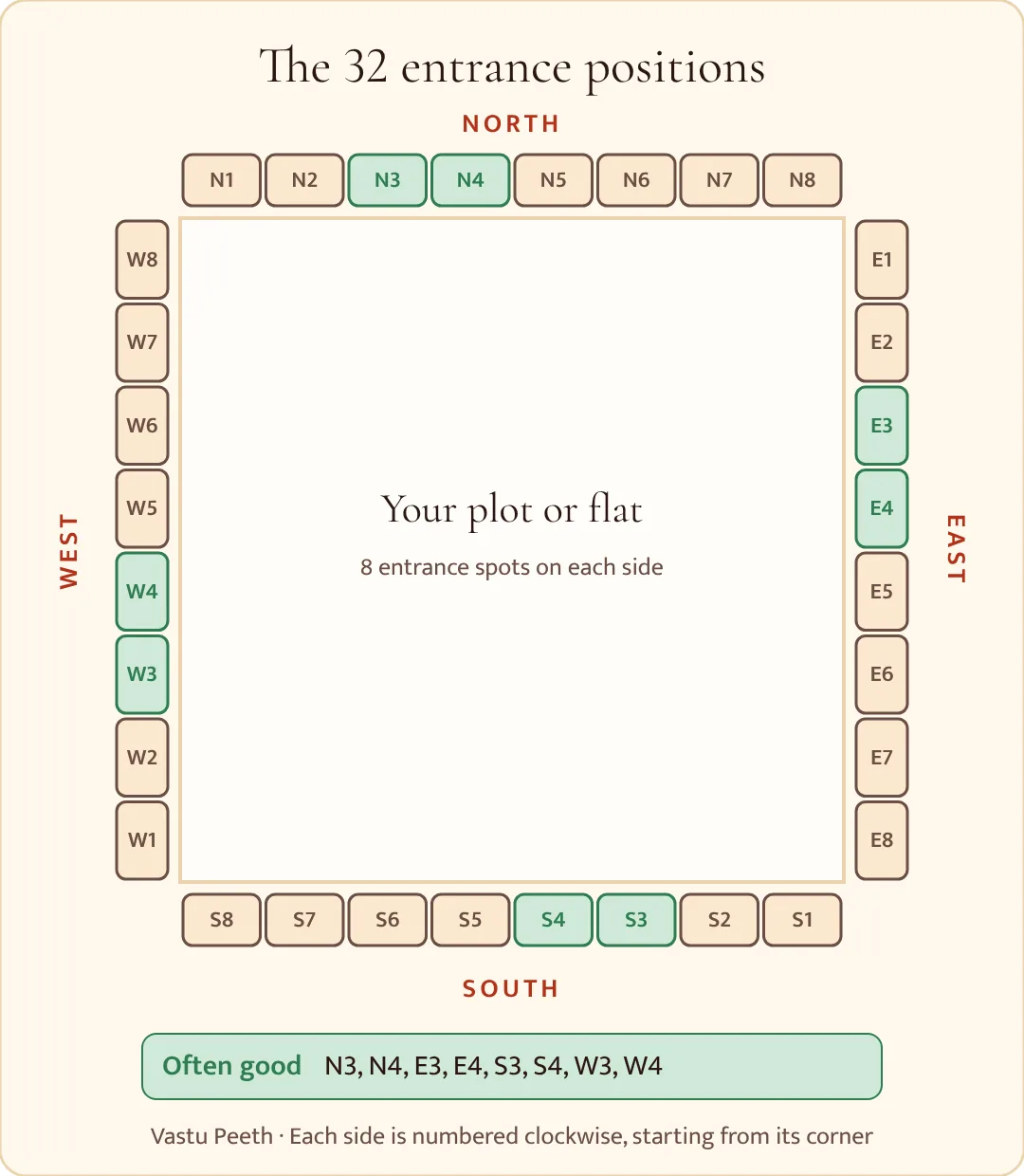
The diagram shows a square plan with eight numbered boxes along each wall. The eight green boxes are the favourable positions. The grey boxes are not all alike. A few of them are linked with clear problems, listed further down, and the rest are read against your plan. The entrance spots sit on the same grid you would use for the 16 Vastu zones of a home.
How to find your own entrance position
You can do a rough check at home in about an hour. Follow these steps in order.
- Get a scaled floor plan from the builder, the owner or an architect.
- Mark the centre of the built-up area. For a plain rectangle, draw both diagonals and use the point where they cross.
- Take a compass reading inside the home, away from steel cupboards, the fridge and wiring. Copy the North line onto the plan.
- From the centre, draw lines that split the plan into 32 equal slices.
- See which slice the middle of your door opening falls in.
If the door straddles two slices, note both. Odd shapes, cuts and extensions shift the centre, so a home that is not a neat rectangle needs more care. Our Vastu guide to entrances covers the basics of reading a plan.
Two slips are very common. Some people stand at the door and call the home “East-facing” without using the centre at all. Others start counting from the wrong corner, so N3 turns into N6 by mistake. Always start each side from the corner named in the list above.
One more tip helps. Take the compass reading two or three times in different rooms and compare. If the readings disagree a lot, something metal is pulling the needle.
Main door Vastu for flats, houses and the main gate
In a flat, the entrance that counts is your own front door. Read it from the centre of your flat, not from the tower lobby or the society gate.
Buyers often ask only which way the door faces. Two East-facing flats can have very different entrances, one at E3 and one at E8. That is why main door Vastu always works with the exact spot, not just the facing.
In an independent house, there are often two entrances to check. The main gate direction as per Vastu is read the same way. Use the 32 slices on the boundary wall, drawn from the centre of the plot. The house door is then read from the centre of the house itself.
If you are still choosing a home, do this check before you sign. Our page on Vastu for buying or renting property explains what else to look at on a site visit. You can also use our Vastu checklist before buying a flat as you walk through each option.
Everyday care for any entrance
Good habits around the door help every position, strong or weak. These are easy to start this week.
- Keep the doorway well lit after sunset, both inside and outside.
- Let the door open fully, without hitting a shoe rack or a wall.
- Oil squeaky hinges and repair a broken bell, lock or handle.
- Keep shoes in a closed rack, not in a heap at the threshold.
- Move the dustbin and old cartons away from the door.
- Fix a clear nameplate that visitors can read easily.
Keep the Ganesha idol off the main door. An idol on or above the door turns him into a doorkeeper and can keep the good out as well. A pair of idols facing opposite ways at the doorway is not a fix either. Place one idol inside, in the West, the zone of gains.
Problem entrances and how to balance them
A few of the 32 positions are linked with clear problems. Each one is balanced with a metal strip or a colour tape on the threshold, matched to the zone. No wall needs to come down.
- E1, W1 and W6: linked with arguments between partners. The threshold gets a strip or tape matched to the zone it falls in.
- W2: linked with insecurity between partners. A white strip across the threshold balances it.
- E8 and S1: linked with money losses, lost work, accidents and red tape in official matters. A red colour tape on the threshold is the usual fix.
- E5, S6 and S7: these hurt the people living there. They need a metal strip suited to the zone.
We still match the position with the problems the family is facing before choosing the remedy. A strip in the wrong place may upset a zone that was fine. So take advice before you fix anything permanent.
For more ideas that leave the structure alone, read our guide to Vastu remedies without demolition.
Quick reference
| Entrance | Linked with | Usual step |
|---|---|---|
| N3, N4, E3, E4, W3, W4, S3, S4 | Favourable | Keep it clean, bright and free of clutter. |
| E1, W1, W6 | Arguments between partners | Zone-matched strip or tape. |
| W2 | Insecurity between partners | White strip on the threshold. |
| E8, S1 | Losses, lost work, accidents | Red tape on the threshold. |
| E5, S6, S7 | Harm to the residents | Metal strip suited to the zone. |
When to ask an expert
A home check is a good idea in a few cases. You are about to buy or rent. The plan has cuts, extensions or an odd shape. The door sits right on the line between two slices. Or the family has faced the same problem for a long time.
Vastu works alongside your own effort. Keep taking legal, money and medical advice from the right professionals where it applies. Our home Vastu consultation reads the entrance together with every other zone.
Main door Vastu is less about fear and more about knowing your spot. Find the position on a scaled plan, care for the doorway, and balance it calmly if needed. To have Acharya Vastav mark your entrance spot on your own plan, book a consultation with us.
Frequently asked questions
Is a South-facing main door bad in Vastu?
No. A South-facing home can be as good as any other. What matters is the exact spot of the door, and S3 and S4 on the South side are favourable positions.
Can I check my entrance with a mobile compass?
A phone compass helps you find North, but it cannot show your entrance position on its own. You need a scaled plan and the centre of the built-up area, then the 32 slices drawn from that centre.
What can I do if my flat entrance is in a weak position?
Most weak entrances can be balanced without any construction. The usual fix is a metal strip or colour tape on the threshold, matched to the zone. A W2 door, for example, takes a white strip, while E8 or S1 takes a red tape.
Should the main gate and the main door be in the same position?
They are checked separately. The gate is read from the centre of the plot, and the house door from the centre of the house, so each can fall in a different spot.
