
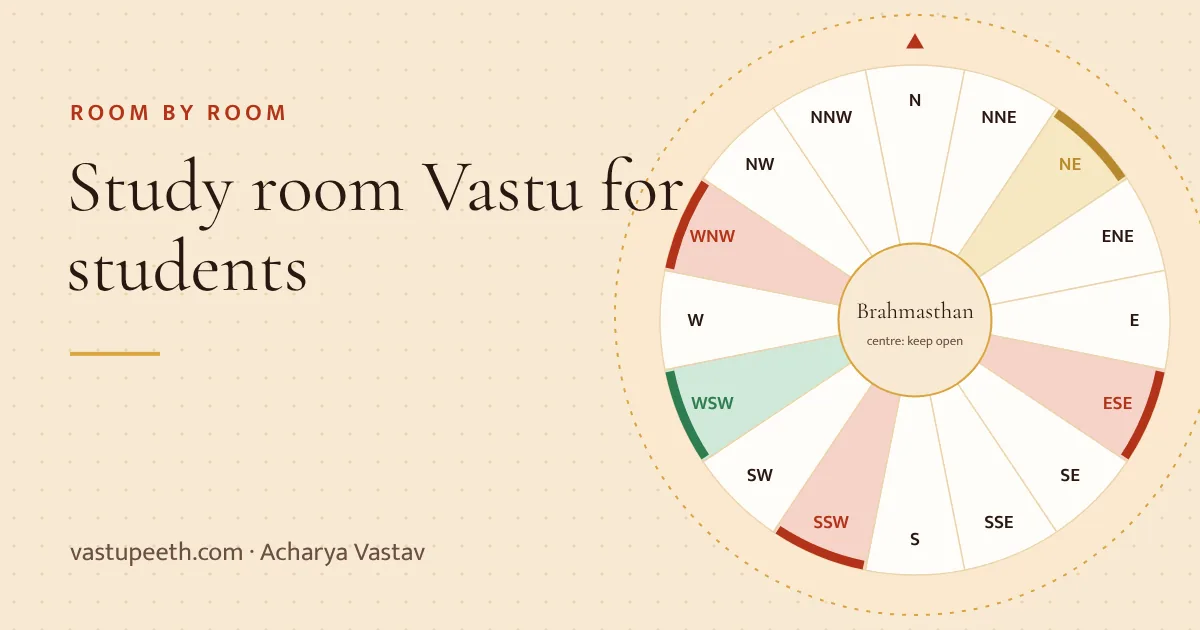
Study room Vastu starts with one zone: the West-south-west (WSW) of the room or the home. This zone governs education and savings. Put the study table here, so the student reads and writes inside this zone.
The North-east (NE) is a good second choice, mainly for research and long reading. For daily study hours, keep away from the South-south-west (SSW), the West-north-west (WNW) and the East-south-east (ESE).
Vastu supports a child’s own effort. It does not replace good teaching, enough sleep or regular practice. Here is how to set up the space, one step at a time.
Study table direction as per Vastu
Every home, and every room inside it, can be read as 16 zones around a centre. For a simple walk-through, see our explainer on the 16 zones of a home.
For studies, the West-south-west comes first. Its element is earth, and white and yellow are its colours. Our West-south-west zone guide gives its full profile.
Find the WSW part of the student’s room with a phone compass held at the middle of the room. Set the desk there, with the chair inside the same zone. In this method, the zone where the student sits decides the effect, so get the zone right first.
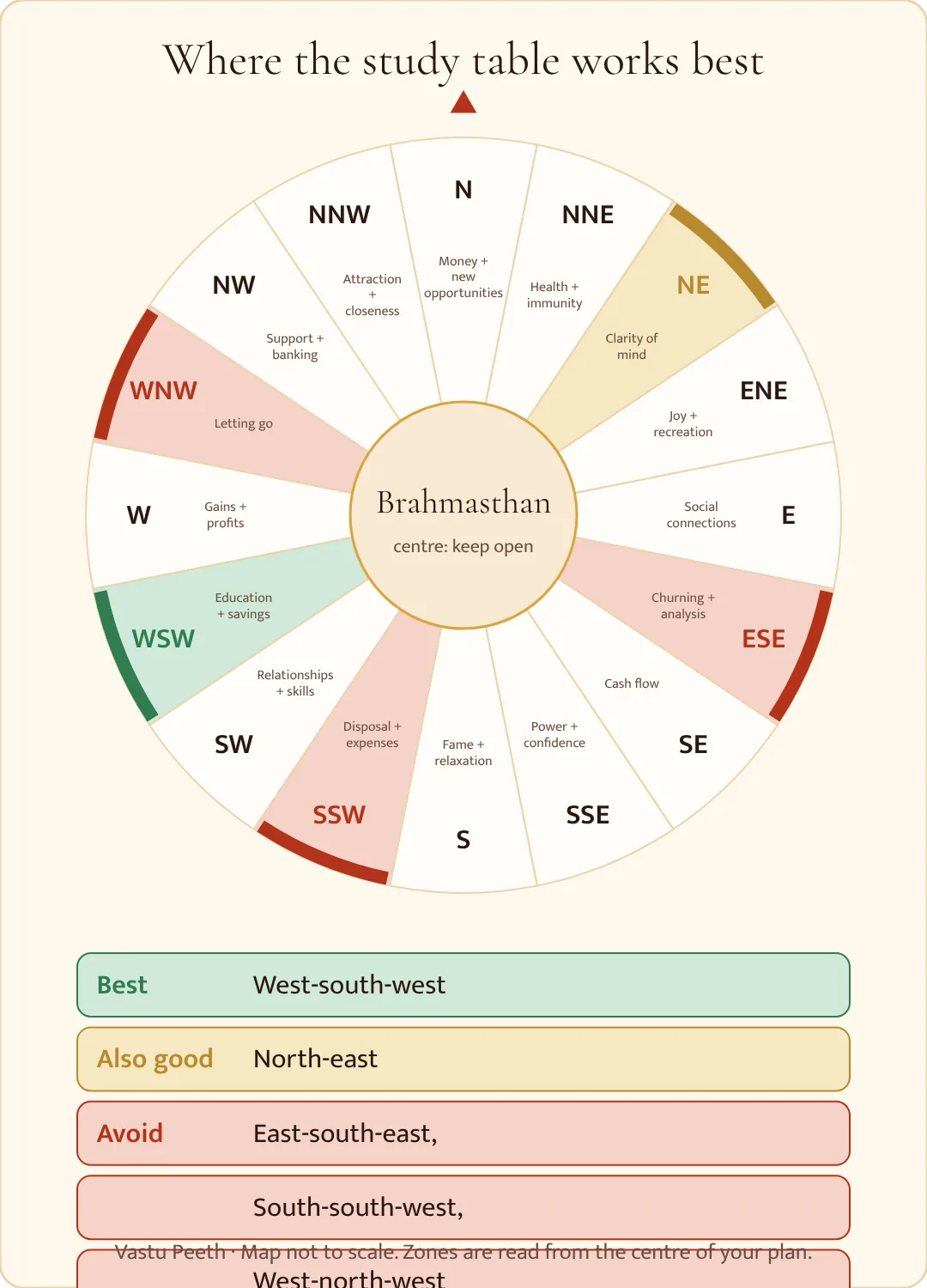
The diagram marks the West-south-west green, as the best zone for the study table. The North-east is gold, a good option for research work. The South-south-west, West-north-west and East-south-east are red.
How the other zones support a student
In study room Vastu, the desk zone matters most, but a few other zones play a part. Here is what each one does and the simple step it needs.
- North-east: linked with clarity. Keep it clear of heavy storage and clutter so thinking stays sharp. It also suits a research desk for an older student.
- East: linked with guidance from teachers and mentors. Keep the East wall bright. A green plant or a rising-sun picture suits it.
- South: linked with rest. A student’s bed works well here, since deep sleep helps the mind hold what was learnt.
- South-south-east: linked with courage. For a child who fears a tough subject, a picture of Hanuman ji here supports confidence.
Three zones are better kept for other uses. The South-south-west handles disposal, so effort there can feel wasted. The West-north-west is about letting go, and study time there tends to drift. The East-south-east is about churning, and long hours there can turn into worry.
Vastu for concentration in studies: the desk itself
Once the table sits in the right zone, the next job is what goes on and around it. Small, clear choices help here.
- Keep books upright on a shelf with the spines showing. A tidy shelf makes it easy to start.
- Put the computer or laptop on the same WSW side of the desk as the books.
- Hang a simple picture of a swan in the West-south-west, near the desk. It is the symbol of focus for this zone.
- Choose white or light yellow for the wall, desk mat or curtain. Leave red, green and black out of the study zone.
- Remove games, toys and the TV from this part of the room. A phone can charge outside the room during study hours.
- Use a steady desk lamp. A dim corner makes long reading tiring.
- Clear old notebooks and used test papers at the end of each term.
For parents, our page on Vastu for a child’s education and focus lists the early signs worth noticing, such as restless study time or slipping marks.
Small habits that keep the zone working
Placement sets the stage, but daily use keeps it working. These habits take a few minutes and suit any home.
- Start each study session by clearing the desk top. Only the books for that subject should stay out.
- Keep the dustbin out of the study corner. Its place is the room’s East-south-east or South-south-west zone.
- Pin the week’s timetable on the wall beside the desk. A clear plan in sight helps a child begin without fuss.
- During exams, keep the study corner for study alone. Meals, chats and phone calls can happen elsewhere.
- Open the window or curtains each morning so the room gets fresh air and daylight.
None of this needs money or building work. It simply keeps the West-south-west calm and ready for use.
Common study room Vastu mistakes
These slips are common in Indian homes, and most of them cost nothing to correct.
- A desk in the South-south-west corner because it was the only empty spot.
- A bed and desk pushed into the West-north-west, where long sitting does not suit.
- A gaming console, toy box or TV right beside the books.
- A bright red, dark green or black wall behind the study table.
- A study table in the East-south-east, where long hours tend to turn into worry.
- Heaps of old papers under the table that nobody sorts.
Fixes for shared rooms and small flats
Many students share a room or study in a corner of the living room. You can still get most of the benefit.
- Work with the room, not the whole house. Find the West-south-west of the room the child already uses.
- If two children share, give the WSW desk to the one with board exams or the heaviest load. Place the second desk in the North-east of the room.
- If the desk cannot move, change what surrounds it. Add a light yellow desk mat, move games away and take red, green and black off the desk.
- In a rented flat, use a freestanding bookcase and lamp so nothing needs drilling.
- Check the wall colours zone by zone with our list of Vastu colours for each direction.
Parents who work from home can use the same thinking for their own desk. Our post on home office Vastu for career growth covers that set-up.
Quick-reference table
| Item | Best zone | Keep out of |
|---|---|---|
| Study table | West-south-west | SSW, WNW and ESE. |
| Research desk | North-east | A cluttered corner. |
| Books and computer | West-south-west | Heaps on the floor. |
| Swan picture | West-south-west | Next to toys or games. |
| Wall colour | White, light yellow | Red, green, black. |
| Student’s bed | South | WNW and ESE. |
When to ask an expert
Vastu for students works best on top of good habits. If marks stay low, talk first with the teacher, and check sleep, eyesight and screen time. Vastu can then make the space easier to study in.
Ask for help if the room has no usable WSW corner, if the zone holds a toilet, or if a shared room keeps causing fights. These cases need a full plan, not a single tip.
Good study room Vastu comes down to the right corner, calm colours and a clear desk. When you want Acharya Vastav to look over your child’s room, you are welcome to book a Vastu consultation.
Frequently asked questions
Where should a student’s study table be placed?
Place it in the West-south-west of the student’s room, or of the home. For research and long reading, the North-east also works. Keep the table out of the South-south-west, West-north-west and East-south-east.
Can the study table be in the bedroom?
Yes, and in most flats it has to be. Set the table in the bedroom’s West-south-west and, if you can, the bed towards the South. Keep games and the TV away from the desk side.
What colour is best for a study room?
White and light yellow suit the study zone. Avoid red, green and black in the West-south-west, on the wall or on the desk. Soft colours keep the eye calm during long reading.
Will Vastu improve my child’s marks?
No one can promise marks. Vastu helps make the space calmer and easier to focus in. The child’s effort, sleep and good teaching still count the most.
